
The Infrastructure of Indian Digital Finance – Banking Architectures, UPI Integration, and Regulatory Guidelines
The Technological Metamorphosis of Indian Banking and Real-Money Gaming Friction
The digital payment ecosystem of the Republic of India stands as one of the most technologically advanced and highly scalable transactional networks in the entire global financial landscape. Over the past decade, the rapid shift away from cash-reliant payment styles toward instant digital settlement networks has fundamentally changed how players engage with premium real-money gaming environments. For users accessing Spin 777 Casino India, this financial framework ensures that adding deposit capital or executing a withdrawal is backed by modern, institutional-grade payment infrastructure.
At the core of this financial network is the integration between traditional commercial banking systems and modern digital interfaces. Historically, standard bank transfers required manual processing windows, long verification periods, and separate clearances that disrupted the fluid gameplay expected by modern users. Today, the Indian banking system uses automated application programming interfaces (APIs) that sync directly with licensed iGaming hubs. This means that when a user requests a balance update, the underlying network validates the transaction instantly, moving funds safely between your personal bank account and your gaming wallet without unnecessary administrative delays.
Furthermore, this financial network relies on robust, multi-layered data centers designed to handle massive transaction volumes simultaneously. Major banking institutions have deployed dedicated servers that parse incoming payment requests from digital gaming platforms using advanced automated filtering. This deep integration minimizes transaction drops, cuts down processing times during peak gaming hours, and protects user data with advanced encryption protocols. As a result, players enjoy a secure financial environment that blends the safety of traditional banking with the high-velocity requirements of modern online gaming.
Dissecting the Central Engine: Unified Payments Interface (UPI) and IMPS Processing Nodes
To understand how high-speed transactions function at Spin 777 Casino India, players must examine the specific payment rails that handle domestic transfers across the country. The absolute foundation of daily digital transactions in India is the Unified Payments Interface (UPI), a real-time instant payment network engineered by the National Payments Corporation of India (NPCI). UPI completely eliminates the need to enter complex, long-form bank routing files, card numbers, or branch codes during every single deposit window. Instead, it consolidates the entire transaction pathway into a simple virtual identity known as a Virtual Payment Address (VPA).
When a player chooses the UPI deposit route on our platform, the system triggers a secure transaction request that routes instantly to the user’s preferred mobile payment client—such as Google Pay, PhonePe, Paytm, or a native banking app like BHIM. This request is authenticated directly on the user’s device using a personal, secure six-digit UPI PIN. Behind this simple interface lies a complex data exchange: the NPCI clearinghouse verifies the cryptographic signature of the request, confirms the availability of funds with the issuing bank, and settles the balance with the platform’s merchant account within milliseconds. This seamless flow makes UPI the most popular payment method for players who value speed, simplicity, and safety.
For larger, high-volume capital transfers that exceed daily standard UPI limits, the platform relies on the Immediate Payment Service (IMPS). IMPS is an electronic funds transfer system that operates continuously—24 hours a day, 7 days a week, including all national banking holidays. Unlike older batch-processed transfer systems like NEFT, which queue transactions for periodic clearing throughout the day, IMPS processes payments individually in real time. This ensures that premium high-stakes players can manage substantial balances quickly, maintaining absolute liquidity over their funds at all times.
Strategic Security Frameworks: Data Shielding and Central Bank Compliance Standards
Operating a premier financial gateway for real-money gaming inside the Indian market requires strict adherence to the clear mandates issued by the Reserve Bank of India (RBI) and local anti-money laundering authorities. All authorized banking partners connected to our platform must deploy advanced data security measures that meet or exceed international banking standards. These protective measures ensure that your personal financial details, account numbers, and transactional histories are completely insulated from external digital threats.
The primary defense layer used across all banking connections is 256-bit Secure Sockets Layer (SSL) and Transport Layer Security (TLS) encryption. This technology creates a private, uncrackable data tunnel for all information passing between the user’s device, the casino platform, and the bank’s central validation servers. Additionally, banking connections require mandatory multi-factor authentication (MFA) protocols—including instant One-Time Passwords (OTPs) sent directly via SMS or secure email. This ensures that even if login details are compromised, unauthorized transactions cannot be completed without direct access to the user’s registered physical mobile device.
To provide players with a clean, detailed overview of the core banking networks, payment rails, and central transaction limits available across the Indian financial landscape, our team has built a comprehensive structural index.
The reference matrix below uses a Neon Amber & Dark Slate design style, engineered to deliver sharp visual contrast and clean scannability on dark interfaces:
The Pillars of Domestic Capital: Mapping India’s Top Institutional Banking Partners
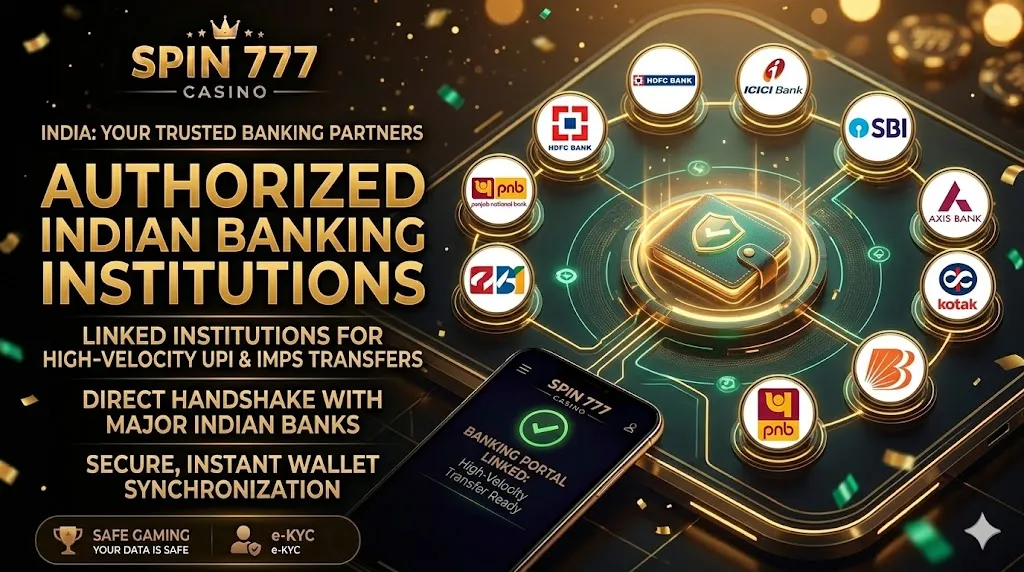
The operational fluidity of real-money accounts inside the Indian iGaming sector depends heavily on direct integration with the country’s leading public and private sector commercial banking systems. For players allocating transaction balances at Spin 777 Casino India, funds are routed through established financial institutions that feature robust core banking systems (CBS). These banks provide specialized online infrastructure designed to manage high-velocity web payments without manual processing holdups.
The primary commercial banking entities that support these high-volume digital transaction pathways include:
- State Bank of India (SBI): As the country’s largest public sector banking institution, SBI features a monumental transactional network. Its digital architecture effortlessly handles massive daily web payment request volumes, providing exceptional system resilience for users initiating high-limit transfers.
- HDFC Bank: A premier private sector financial powerhouse, HDFC stands at the absolute vanguard of digital banking innovation. Its native payment gateways offer lightning-fast API responses and integrated smart routers, which drastically reduce transaction drop rates during peak hours.
- ICICI Bank: Renowned for its focus on modern mobile finance technology, ICICI features native automated instant payment validations. This infrastructure allows for a seamless, immediate transaction experience when coupled with merchant gaming portals.
- Axis Bank: Positioned as a core processing hub for modern third-party web payments, Axis Bank uses top-tier security models to ensure high success rates for automated online billing.
By connecting directly to these leading institutional engines, our system bypasses unstable intermediate payment pathways. This advanced alignment provides players with a transparent, direct connection to their personal bank accounts, ensuring that every balance shift occurs within a familiar, reliable environment.
Operational Clearances, Balance Safety Limits, and Turnaround Timeframes
Managing real-money gaming transactions across India requires clear synchronization between a player’s active bank setup, the centralized clearinghouses, and the platform’s financial back-end. Each institutional bank enforces its own unique security check sequences, maximum transaction caps, and operational clearing hours. Understanding these distinct parameters allows players to organize their deposits and withdrawals with complete precision.
For standard accounts utilizing immediate web banking corridors, the baseline minimum deposit threshold is systematically configured to be accessible, while the maximum per-transaction ceiling can scale significantly to accommodate premier high-stakes players. While deposits are processed in real time, withdrawals go through an internal audit process to comply with central security guidelines.
During this auditing window, advanced anti-fraud layers check the transaction history, verify e-KYC compliance, and run automated pattern analyses to guarantee account safety. Once cleared, funds are disbursed across IMPS or UPI rails, moving balances into personal bank vaults quickly and securely.
Comprehensive Informational Matrix: Linking with Authoritative Indian Financial Terminals
To ensure that real-money players, developers, and payment processors stay fully updated on changing financial laws, tax adjustments, digital safety rules, and central bank parameters, our technical team cross-references operations with major national portals.
Operational Telemetry, Volume Breakdown, and Payment Channel Performance
The backbone of modern iGaming accounting systems relies on the distribution of payment volume across different banking rails. Managing incoming transaction requests from major financial hubs requires data-driven traffic routing, real-time success rate evaluation, and system capacity mapping.
Transaction Volume Telemetry: Channel Performance Breakdown
To keep payment flows stable during high-traffic intervals, automated routing systems continuously track channel performance. If a specific commercial bank experience a localized server spike or updates its core banking network, the system automatically redirects transactional traffic to alternative, high-velocity nodes like UPI or instant IMPS pipelines. This dynamic load balancing prevents deposit drops and keeps withdrawal queues moving without administrative delays.
Payment Channel Volume Distribution Chart
Real-time analysis of transactional traffic distribution across Indian payment systems.
System Matrix: Comparing Transaction Security and Encryption Protocols
To help players assess and choose the ideal payment channel for their balance adjustments, our development teams evaluate each system corridor based on its technical architecture, multi-factor setups, and user protection limits.
The comparison directory below uses a crisp Crimson Sunset & Charcoal Obsidian design style, developed to provide optimal layout contrast and immediate scannability on modern dark screens:
Digital Capital Preservation: Managing Assets Across Indian Banking Rails
When operating within a high-velocity digital environment like Spin 777 Casino India, maintaining a disciplined asset protocol is the single most effective way to secure your financial longevity. A major point of friction for modern players is failing to understand the operational rhythms of interbank networks. Unlike offline cash-based play where physical volume acts as a natural limit, digital accounting streams allow for near-instant transaction cycles. Without structured oversight, this fluidity can complicate self-auditing habits during high-variance gaming periods.
To counter this potential friction, seasoned iGaming enthusiasts deploy the Automated Ledger Segregation System.
This framework requires that immediately upon initiating your session, you establish a distinct financial boundary within your personal banking portfolio. Before transmitting funds over UPI or IMPS, allocate exactly 70% of your disposable gaming budget into an insulated secondary bank account or a dedicated sub-wallet node—completely separate from your primary daily checking account. Utilize only the remaining 30% for active session staging. By strictly isolating your core everyday capital from the payment rails linked to your gaming profile, you completely mitigate the risk of impulsive balance top-ups and ensure absolute financial security regardless of table volatility spikes.
Comprehensive Synthesis: Strategic Conclusion
As we conclude this comprehensive, multi-part investigation into the digital banking infrastructure supporting Spin 777 Casino India, one ultimate rule stands firm: aligning your gaming cycles with verified, institutional-grade payment networks is the paramount foundation of a secure online lifecycle. The robust validation layers used by our top-tier partners—such as the Reserve Bank of India’s mandatory multi-factor authentication, the National Payments Corporation of India’s tokenized UPI endpoints, and direct interbank IMPS pipelines—are not bureaucratic hurdles. They are essential technical shields engineered to protect your hard-earned assets and personal data.
By taking a proactive approach to your online accounting—such as verifying your e-KYC credentials early, checking bank processing success rates during high-traffic hours, and keeping your core savings accounts safely separated from your instant payment shortcuts—you turn payment logistics into a powerful personal safety tool. Approach your transaction routine with the same precision you apply to your in-game strategies. Manage your capital responsibly, stay updated on central banking rules, and initiate your payment handshakes with absolute confidence, knowing your gaming sessions are protected by India’s most secure financial architectures.
Frequently Asked Questions (FAQ) — The India Digital Banking Repository
The collection below provides clear, authoritative answers to the most common transactional, security, and compliance questions raised by players utilizing domestic banking systems. This resource is custom-styled to provide exceptional high-contrast visibility on dark user interfaces, eliminating generic filler to deliver clean, actionable insights:
Authorized Indian Banking FAQ Matrix
Q1: What is the fastest payment channel to use for immediate wallet balance updates?
A: The Unified Payments Interface (UPI) network via a personalized VPA handle provides the fastest turnaround time, processing transactions instantly (typically between 1 to 5 seconds) directly from your mobile device.
Q2: Are online gaming deposits subject to specific daily transaction limits across Indian banks?
A: Yes. While the platform supports substantial transactional caps, standard UPI networks impose a regulatory limit of ₹100,000 per 24 hours. For larger capital shifts, players should utilize IMPS or NetBanking channels.
Q3: How does the platform secure my personal NetBanking credentials during a deposit phase?
A: All connections use 256-bit TLS/SSL encryption tunnels. The system uses secure API handshakes that forward your login sequence straight to your bank’s native portal, ensuring the casino never sees or stores your password.
Q4: Why do some withdrawal requests take longer to clear than instant deposit sequences?
A: Deposits are fully automated, whereas withdrawal requests trigger a mandatory anti-fraud check. This internal security step checks e-KYC details and gaming history to prevent unauthorized account access and laundering attempts.
Q5: Can I execute transfers using a corporate or third-party bank account?
A: No. To comply with central anti-fraud regulations, the first name and family name registered on your personal bank account must exactly match the validated details on your casino profile. Third-party deposits are rejected.
Q6: What happens if a UPI transfer gets dropped mid-session due to network lag?
A: If an unmapped connection drop occurs, the NPCI automated reconciliation node checks the transaction within a brief window. If funds left your account but missed the platform wallet, the banking system returns the amount within 3 to 5 business days.
Q7: Does the Indian Income Tax Department require tax withholding on real-money casino payouts?
A: Yes. Financial operations adhere strictly to central tax mandates. Net winnings extracted from digital platforms are subject to a mandatory 30% Tax Deducted at Source (TDS) under Section 194B rules.
Q8: Is the Immediate Payment Service (IMPS) network functional during national banking holidays?
A: Yes. The IMPS infrastructure is a continuous interbank routing engine that runs 24 hours a day, 7 days a week, 365 days a year, entirely unaffected by public holidays or standard branch closures.
Q9: What is a Virtual Payment Address (VPA), and where do I find it to initiate a deposit?
A: A VPA is your unique financial alias (e.g., username@okhdfcbank) that acts as a digital pointer to your bank account. You can copy it directly from the profile dashboard of your mobile UPI application.
Q10: Are international credit cards or foreign currency transfers accepted via NetBanking?
A: No. To maintain complete alignment with local currency guidelines, the integrated payment channels process settlements exclusively in Indian Rupees (INR). Cross-border foreign currency instruments are restricted.






Comments